

School Life
Pastoral Care
Home » School Life » Pastoral Care
Kindness, Spirit and Responsibility
At More House School we believe that every child has the right to learn within a happy, supportive and safe environment. This is only possible through rigorous Safeguarding, underpinning the pastoral care provided in the school. We aim to instil self-confidence in all pupils, whatever their abilities and help them to fulfil their potential through furthering self-belief, a sense of belonging and nurturing their natural desire to learn. We see it as important to develop a sense of community and to teach pupils to have empathy and respect for people from all backgrounds.
A pastoral approach founded in our school’s ethos of Kindness, Spirit and Responsibility
Form Tutors
Each pupil is a member of a form group comprising approximately twelve pupils. They have a single Form Tutor who meets with the group at the beginning of every school day and at the end of the day’s lessons. The Form Tutor becomes the central point for communications regarding the academic progress and pastoral support of the pupils within their form group. The Form Tutor is usually the first point of contact for parents and subject teachers, and liaises with other members of the school’s staff as appropriate regarding pupils in their form group.
Heads of Year
Oversight of the academic and pastoral support of pupils within each year group is provided by the Head of Year, who meets regularly with each Form Tutor in the year group. Additional support is provided by a Mentor who meets their allocated mentees one-to-one on a regular basis and supports them pupil to weekly challenges which combine to address his annual therapeutic targets, agreed between the pupil, his parents and the school at his Annual Review meeting.
In cases where further support is needed, this is provided via the Pastoral Plus system which involves a member of staff working individually with the pupil to provide support. This may lead on to counselling or involvement with outside agencies, if appropriate.
Parents and pupils receive half-termly grades together with an annual full school report, attend an Annual Review meeting conducted by a senior member of the school staff, and attend an annual parent and teacher consultation evening at which parents and their sons have the opportunity to meet with subject teachers, therapy staff, their Form Tutor and the Head of Year to discuss progress and needs.
Our sanctions and rewards policies are age appropriate and implemented rigorously – they are detailed, specifically, within the Behaviour for Learning Policy, located through the Policies page.
Similarly, a proactive approach to anti-bullying is immensely important to every member of the school community, and it is believed that this can only be achieved in a setting where the development of self-esteem and a sense of belonging is prioritised. In doing so, we are better placed to address instances of counter-connecting (misplaced attempts to form relationships), or indeed negative interactions.
Safeguarding remains, at all times, the highest priority within the school. Led by the Headmaster, Safeguarding arrangements are coordinated by the Head of Safeguarding and Designated Safeguarding Lead (DSL), Mrs Lee, supported by the Deputy DSLs. The school’s Safeguarding Policy can also be accessed from this website through the Policies page. To find out more, explore the Safeguarding section on the website.
Behaviour for Learning
As a school we aim to create a positive ethos, with good relationships, equality of opportunity and respect for each other. We believe that the promotion of positive behaviour is fundamental to a happy learning atmosphere which promotes a thirst for knowledge and learning, and high standards of educational achievement. Our rewards and sanctions approach within our Behaviour for Learning Policy aims to set out the methods by which we encourage and promote positive behaviour and deal with unacceptable behaviour.
It is important that a consistent approach is applied across the school towards fostering pupils’ behaviour, and that good behaviour is seen to be rewarded and poor behaviour is dealt with appropriately. For this purpose, More House School operates a reward and discipline system called Behaviour for Learning. This scheme enables Form Tutors, Heads of Year and Deputies to follow individual instances and patterns of good and poor behaviour. We believe that students should be encouraged to make positive choices and that these should be recognised and rewarded. Heads of Year will coordinate a rewards system appropriate to the pupils within their own year group.
House Points are given to reinforce and encourage further good behaviour. The whole school community provides these incentives and rewards which may be given to an individual, group or whole classes working together.
Sanctions are structured to ensure that pupils can be encouraged and supported in improving subsequent behaviour. The majority of unacceptable behaviour is discouraged through verbal warnings. All adults in the school have an equal right and responsibility to remind pupils of the school’s rules and to expect pupils to behave appropriately.
It needs to be acknowledged that for a few pupils, the sanctions and rewards of the school will be insufficient to ensure their wellbeing and that of the other pupils in the class. On very rare occasions it may be necessary to exclude a pupil on a temporary or permanent basis. A decision to do this is not undertaken lightly, will usually be influenced by appropriate consultation, and not without giving due consideration to every possible alternative first. It is acknowledged that most pupils and their parents prefer to work towards a positive solution to difficulties and appreciate the opportunities the school can offer in encouraging a pupil to feel able to secure their own future within the school environment.
The 4 School Houses
Everyone at More House School is a member one of our four Houses.
Pupils can tell which other boys are members of their House by looking at the colours on their tie. Students also wear a P.E. kit in the colours of their House. All members of staff are also allocated a house.
Across the day school and boarding, House Points are awarded for representing our core values: Kindness, Spirit and Responsibility. Pupils in every year group can earn House Points, which may be given for positive or consistent behaviour, as well as exceptional academic progress and mentoring tasks. There are also various opportunities for pupils to represent their House throughout the year, including inter-house sports competitions and our annual Sports Day. Music and Drama are also celebrated with House Points.
In the last week of every half-term, we hold a House Ceremony assembly. All of the House Points are counted, and the winning House receives a special prize. Individual achievements are also recognised. All House Points earned across the school year contribute towards the highly sought after House Cup which is awarded at the end of Sports Day each summer.
Click on each of the titles below to learn a bit more about each House:
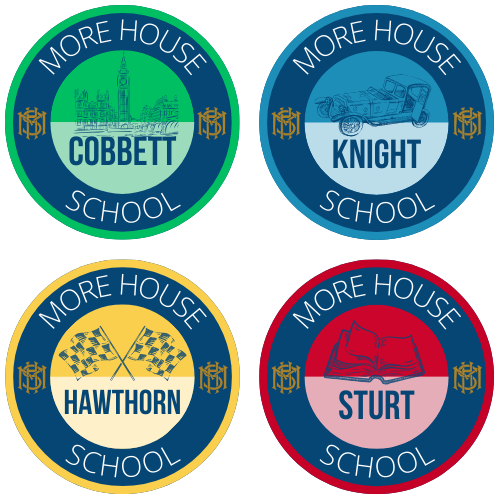
Cobbett
Cobbett House is green and is named after William Cobbett (1763-1835), one of the most influential people Farnham has ever produced. He was a professional soldier, farmer, publisher and author, as well as becoming a Member of Parliament for Oldham. He thought that the reform of Parliament and the abolition of the rotten boroughs would help cure the poverty of the farm labourers. Cobbett constantly attacked the borough-mongers, sinecurists and ‘tax eaters’. He opposed the Corn Laws, a tax on imported grain. Through the many apparent inconsistencies in Cobbett’s life, one strand continued to run: an ingrained opposition to authority and a suspicion of novelty.
Hawthorn
Hawthorn House is yellow and is named after Mike Hawthorn (1929-1959) who made his name in motor racing circles and finished fourth in the 1952 World Championship. He went on to win the Driver’s World Championship from Stirling Moss, as well as the French Grand Prix in 1953 and was the winner of the 1958 Formula One Championship. Hawthorn was noted for wearing a bow tie when racing and to the French, he became known as ‘Le Papillon’ (The Butterfly). In Farnham, the town where he lived up to the time of his death there is even a street ‘Mike Hawthorn Drive’ named after him.
Knight
Knight House is blue and is named after John Henry Knight (1847-1917) who was born to a wealthy family in Weybourne House in Farnham and was able to pursue a wide variety of interests. As a result, his three-wheeler was billed as the only British built car propelled by internal combustion. He also invented what is widely believed to be the first ever petrol-driven car for the road in 1895, which he exhibited at the Crystal Palace Show in 1896.
Sturt
Sturt House is red and is named after George Sturt (1863-1927) who was born, lived and worked in Farnham running the family wheelwright’s business. He was also a talented author, writing numerous books and articles under the name George Bourne. Sturt’s first published book was ‘A Years Exile’ about country life among the people of Surrey. He also wrote ‘The Wheelwright’s Shop’ as well as ‘A Small Boy in the Sixties’, a book about his childhood in Farnham, continuing to write even after being partially paralysed by an illness.
Pupil Voice
Pupils from across the school are democratically elected to become members of the School Council, where pupils represent views and expressions from their year groups. With the Chair selected from the prefects of the Sixth Form, an agenda is arranged in accordance with the suggestions made, offering all pupils the freedom of sharing any concerns raised, or methods by which school improvement can be made.
Frequently, the School Council offers pupils an opportunity to discuss whole-school change, with senior leaders of the school offering a method by which pupils can communicate any specific findings depending on the area of focus.
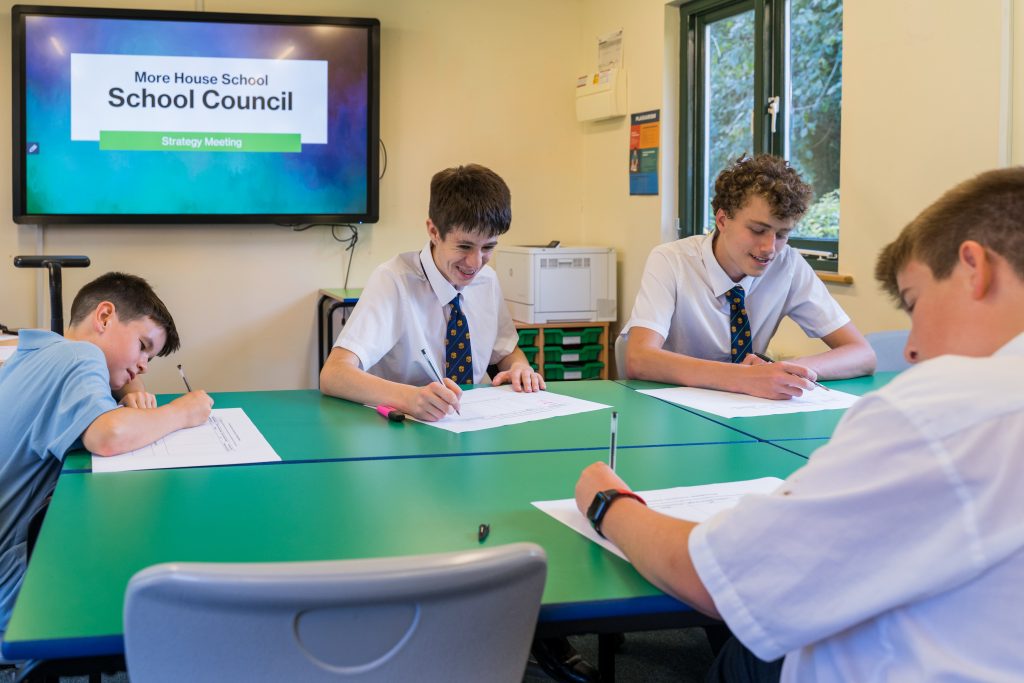
The School Council brings together members of the Food Council, as well as the Boarder’s Council, ensuring that the pupil vision can be consistent across all areas.
In recent years, the School Council has selected charities for school support in whole-school events, discussed considerations for the Estates Team, and have been in discussion regarding curriculum reform or pastoral considerations, including the Statement of Purpose and Anti-Bullying policy. These are all areas of major focus for the school, and ensuring a pupil-focus in this area is critical.
All pupils are invited to nominate themselves to become part of the School Council at the beginning of each school year, and are asked to produce a speech, or equivalent, to share their vision for the future of the school.
Wellbeing
At More House we believe in building character as much as we are dedicated to fostering academic achievement. The school tailors its approach to meet individual need and is strong in its commitment to caring for the ‘whole’ child; the staff take seriously their duty of care to pupils and monitor physical, emotional and mental wellbeing closely.
We aim to teach both an explicit and implicit curriculum to enable pupils to grow and flourish alongside achieving academically. We believe in a whole-school approach, which is staff-led and places the students at its core.
All staff are responsible for promoting good mental health and emotional wellbeing, but it is the Form Tutors who play a major role in supporting wellbeing. Our Form Tutors and Heads of Year are usually the first point of call for pupils and parents, but we also have on-site counsellors, nurses and a Lay Chaplain. A team of staff works on shaping the curriculum and supporting staff in embedding a wellbeing ethos throughout the school, to raise awareness, foster good mental health and bring about positive change.
It is possible that any pupil during their time at the school may exhibit anxiety or low self-image, leading to reduced levels of achievement, determination, and engagement. Therefore, significant emphasis is placed on wellbeing to include raising self-esteem and reducing anxiety – for example:
- Staff are trained to be aware of causes for concern, such as poor health, anxiety or low mood, and to recognise the signs that a pupil is feeling anxious or low.
- Rewards systems are in place for pupils, and the school acknowledges the need to praise and reward in various ways.
- PSHE lessons educate and inform individuals, raising the awareness of wellbeing and promoting positive mental health.
Our School Counselling Service is a team of three qualified, registered Counsellors who improve the emotional wellbeing and mental health of our pupils and students. They work across all the age groups and usually start with a block of 12 sessions. Staff, parents and carers are able to ask for counselling for the children and young people at More House, and the older students are also able ask for this support themselves.
The Counsellors establish a therapeutic relationship with the child or young person through acceptance, trust and empathy, providing them with a safe space to talk about their experiences and process feelings in their own way and pace. Depending on the individual stage of the pupil, the Counsellors may utilise a combination of therapeutic play, art therapy or talking therapy. Counselling sessions are all confidential unless there is a risk of harm to self or others.
Chaplaincy
The Catholic foundation upon which More House School is built looks to Christ as the perfect model of love for all our friendships and interactions to emulate, irrespective of individual beliefs and backgrounds. Chaplaincy helps us to:
Celebrate our school
Pupils often take an active role in the formation of materials and delivery of our assemblies, liturgies and celebrations of the Mass. Our liturgies focus on the seasons of Christmas and Easter, whilst our assemblies allow us to reflect on the real-life application of Christian values such as kindness, generosity, loyalty and respect. Mass is celebrated periodically throughout the year in the chapel—a place of quiet reflection located in the heart of the school grounds.
Provide formation/focus on the whole person
As well as academic excellence, our school encourages students to develop a spirituality which helps them to see beyond the physical and material, helps them in times of need, and which gives them strength and confidence in their everyday lives. Chaplaincy works closely with the PHSE and the Wellbeing departments to fulfil this aim.
Embrace others/be inclusive
Social respect is a very important element of life at More House and this ethos is embedded into everything we do. Chaplaincy shows us how we can hold our own beliefs and yet maintain meaningful, inclusive relationships and learn from those who believe differently to us.
Support our pupils
Above all else, the Chaplain’s raison d’etre is to reflect the values and beliefs of More House in her pastoral support for the whole school community. The Chaplain provides an open and listening presence and is available to meet with students on a one-to-one basis.
PSHE
At More House School, Personal, Social, Health and Economic Education (PSHE) helps students become healthy, independent, and responsible members of society. Through PSHE, pupils build self-confidence and are encouraged to contribute positively to school life and the wider community. The curriculum is taught to all students, regardless of ability, and includes e-Safety, Relationships Education for Junior Years, and Relationships and Sex Education (RSE) for Year 7 and above.
Our dedicated teaching staff tailor learning to individual needs, with most PSHE lessons delivered by the student’s Form Tutor to foster trust and a supportive environment. The curriculum focuses on understanding rights and responsibilities and promotes respect for diversity and British Values. PSHE at More House is a dynamic, evolving programme that responds to the real-life issues students face.
The RSE policy can be viewed on the Policies page.
